



How to Set Aging Duration on a Power-On Aging Line
Time:
2026-10-31 08:27
Source:
Author:
How long a product should age on a power-on aging line is a question that trips up many factories. Set it too short and early failures slip through; set it too long and you tie up capacity and burn money. The core principle: aging duration must let a product's early failures surface fully, without pointless idle running.
Aging duration is closely tied to product type. The purpose of power-on aging is to screen out the problems that tend to appear early in real use — cold solder joints, poor contact, early component drift and unstable power. Most of these concentrate in the first few dozen hours of power-on. So aging duration must cover the product's early-failure window.
How is it set? First, look at product complexity. Products with more integrated modules and more solder joints have a longer early-failure window, so they age longer; simple products can age shorter. Second, look at operating conditions. Products that run 24/7 need a longer aging time to simulate real load; intermittently used products can age shorter. Third, look at historical data. The past aging defect rate of the same product line is a key basis — wherever the defects cluster, the aging duration should cover up to there.
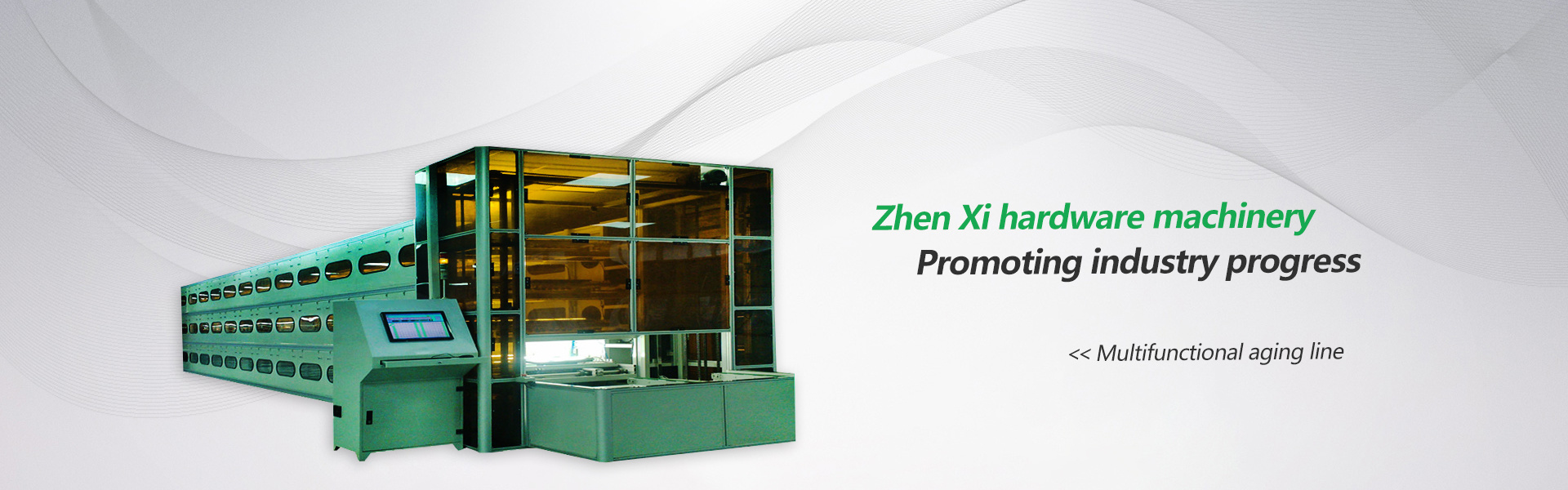
Aging duration must match the aging line's staging. An aging line is staged by voltage level — low voltage, normal voltage, high voltage, surge, then roaming — and the time of each stage can be set independently. Power-on aging never cuts power, the product stays energized from start to finish, and the aging duration is the total energized running time of the whole line.
An aging line is non-standard customized, with duration, voltage levels and staging all following the product. Zhenxi Automation has built aging lines for years and can set the aging duration around your product process and historical data, from planning through installation and commissioning. To set the right aging duration, message us, or visit www.cnzhxi.cn.
Related news

undefined
Shenzhen Zhenxi Automation Equipment Co., Ltd
Zhenxi Automation (Huizhou) Co., Ltd

Technical consultation: 13421327150 (Mr. Yang)

Service consultation: 13421327150

Shenzhen Company: No. 15, Tongfu Industrial Zone, Jiangshi Community, Gongming Street, Guangming New District, Shenzhen
Factory address: Building 19, Xinli Kangle Chuangcheng Phase III, Shuikou Street, Huicheng District, Huizhou City

Website two-dimensional code
Copyright ©2018 Shenzhen zhenxi hardware machinery co., ltd.
Powered by www.300.cn